A Landmark Success for the Inaugural African School of Evaluation (ASE)
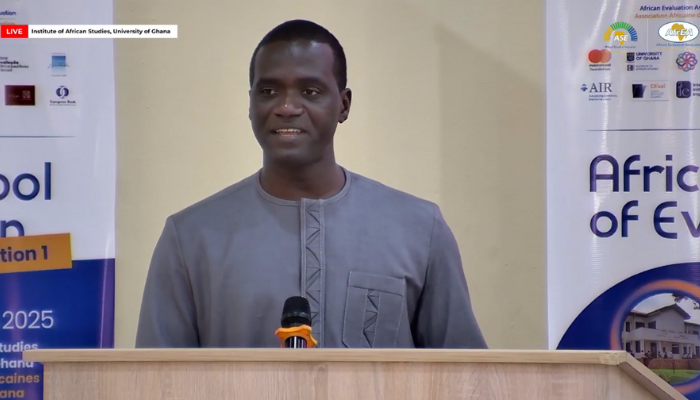
A new chapter in the continent’s development history was written at the Institute of African Studies, University of Ghana from November 24 to 28, as the first-ever African School of Evaluation (ASE) successfully brought together a new generation of practitioners to professionalize African evaluation practice.
The ASE was conceived to bridge a critical gap: while the demand for evidence-based policy has surged, formal and structured evaluation training has remained scarce across the continent.
The school’s mission is to move beyond “donor-satisfaction” and instead contribute to good governance by equipping African professionals with the skills to lead evaluations “by and for Africans.” This initiative directly supports the “Made in Africa Evaluation” (MAE) approach, ensuring that rigorous international standards are rooted in African cultural and social realities.
A Week of Intensive, High-Level Specialized Training
The 2025 edition offered five days of immersive learning, featuring thematic tracks facilitated by world-renowned institutions. These modules were designed to be immediately applicable to the complex challenges facing African public administrations and NGOs.
1. Evaluation in the Service of Equity
Facilitated by CLEAR Anglophone Africa, this track challenged participants to view evaluation as a tool for social justice. By exploring “Equitable Evaluation” approaches, practitioners learned to address structural inequalities—economic, political, and social—that persist despite decades of development interventions.
2. Impact Evaluation: Theory and Applications
Led by the American Institutes for Research (AIR), this technical module focused on the “how-to” of measuring true program impact. Participants engaged in hands-on STATA sessions, mastering experimental designs, matching, and discontinuity designs to ensure that African development projects are backed by the highest level of statistical evidence.
3. M&E in the Age of Artificial Intelligence
CLEAR Francophone Africa spearheaded a forward-looking module on the digitalization of M&E systems. In the context of the shift toward program budgeting, participants explored how AI and digital dashboards can modernize public administration, moving away from manual, fragmented data collection to real-time, interoperable systems.
4. Mixed Methods in Action
The National School of Public Administration (ENAP, Quebec) delivered a balanced track on integrating qualitative and quantitative techniques. This module emphasized the importance of entering the field with appropriate tools—such as surveys and observations—to ensure that findings are credible and contextually relevant.
5. Specialized Tracks for Youth and Children
With support from UNICEF and other partners, the program also emphasized thematic evaluations focused on social sectors, ensuring that the needs of Africa’s most vulnerable populations remain at the heart of the evaluative process.
The school has birthed a pan-African network of evaluators who will continue to share resources, data, and methodologies long after the closing ceremony, and the success of this first edition paves the way for the AfrEA Secretariat and its partners outline a clear roadmap for the future:
- Annualization: The ASE will become a permanent annual fixture, to ensure a consistent pipeline of evaluation talent.
- Theme Evolution: Future sessions will adapt to emerging continental priorities, such as climate change evaluation and the continued integration of AI in governance.
- Institutionalized Funding: Transitioning to a sustainable model with the support of national governments and international partners to ensure the school remains accessible to Young and Emerging Evaluators (YEEs).
“Evaluation is the pulse of development. Through the ASE, we are ensuring that Africa’s heart beats with accuracy, equity, and excellence.”




Responses